
Kia’s Evolving Electric Vehicle Strategy
Kia has made significant strides in the electric vehicle (EV) market, driven by a strategic vision known as “Plan S.” Announced in 2020, this ambitious plan outlined Kia’s commitment to electrification, digital innovation, and advanced mobility services. A cornerstone of this strategy is the expansion of its electric vehicle lineup, moving beyond traditional internal combustion engine vehicles and plug-in hybrids to focus on dedicated battery-electric vehicles (BEVs).
At the heart of Kia’s modern EV architecture is the Electric-Global Modular Platform (E-GMP). Co-developed with Hyundai, this platform is specifically designed for battery-electric vehicles, allowing for optimized battery placement, faster charging capabilities, and enhanced interior space. This dedicated EV platform eliminates many of the compromises associated with adapting gasoline-powered vehicles for electric power, paving the way for a new generation of electric Kia cars that are both efficient and practical.
Current Kia EV Models Available in the US (2026 Model Year)
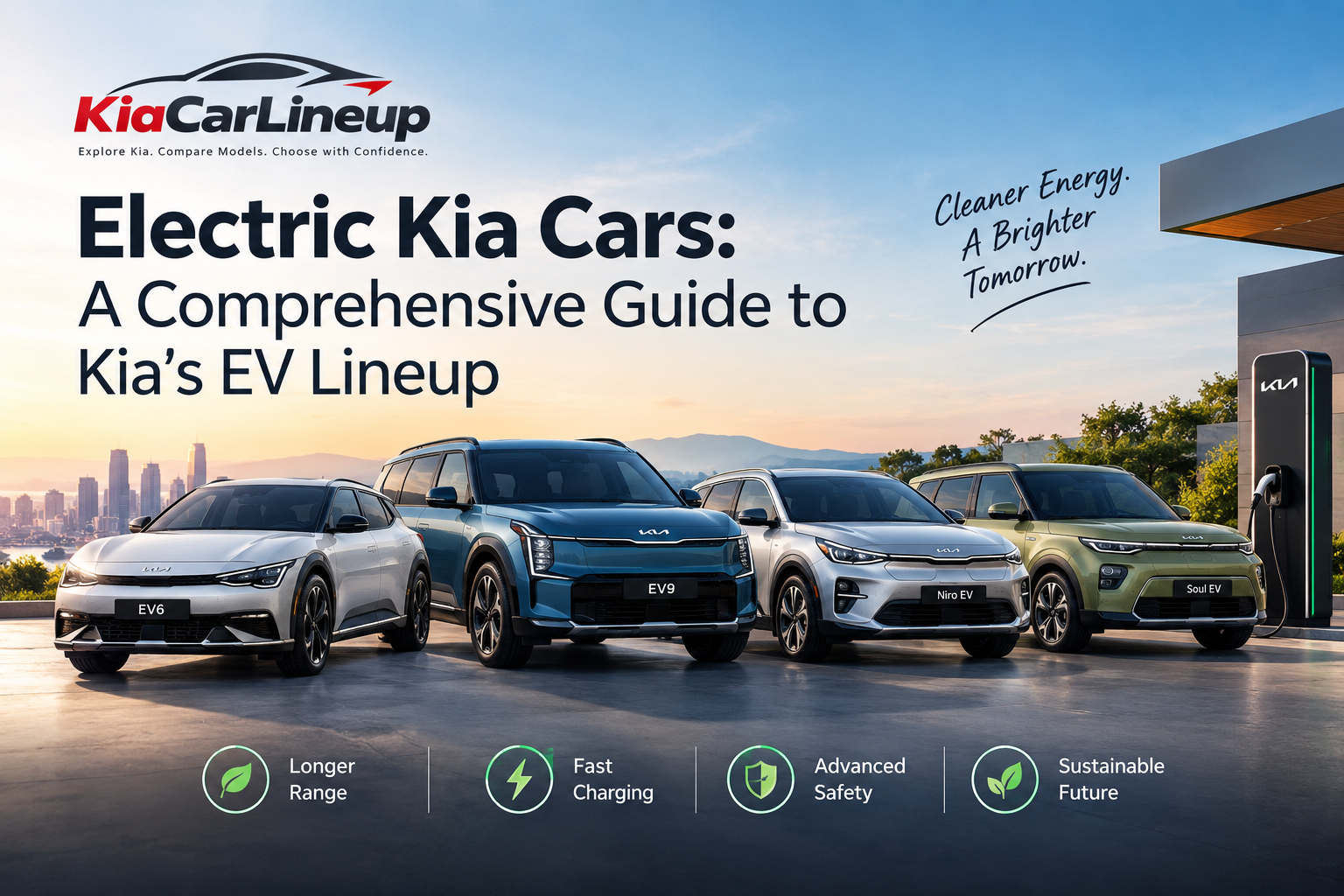
For the 2026 model year, Kia’s US electric vehicle lineup includes models such as the Niro EV, EV6, and EV9. Each model caters to different preferences and driving needs.
Here is a closer look at these vehicles and their key specifications.
1. Kia Niro EV
The Kia Niro EV is a compact electric crossover designed for urban commuters and budget-conscious buyers.
- Body Style: Compact crossover
- EPA-Estimated Range: 239 miles
- Battery Capacity: 64.8 kWh (NMC)
- Maximum DC Fast-Charging Power: Approximately 85 kW (400V)
- 10–80% DC Fast-Charging Time: Approximately 43 minutes
- 0–60 mph Acceleration: Approximately 7.2 seconds
- Horsepower: 201 hp
- Starting MSRP: Approximately $39,600
The Niro EV uses a 400V electrical architecture, which is common among many electric vehicles. Although its DC fast-charging speed is lower than that of some 800V models, it remains a practical option for everyday driving, particularly when paired with reliable Level 2 home charging.
It is well suited to drivers who typically travel shorter distances and primarily commute in urban or suburban environments.
2. Kia EV6
The Kia EV6 is a midsize electric crossover that combines performance, driving range, and advanced charging technology.
- Body Style: Midsize crossover
- EPA-Estimated Range: 232–310 miles, depending on configuration
- Battery Capacity: 58–77.4 kWh (NMC)
- Maximum DC Fast-Charging Power: Up to 239 kW (800V architecture)
- 10–80% DC Fast-Charging Time: Approximately 18 minutes under suitable conditions
- 0–60 mph Acceleration: Approximately 3.4–7.2 seconds, depending on trim
- Horsepower: 167–576 hp, depending on configuration
- Starting MSRP: Approximately $42,900
One of the EV6’s key advantages is its 800V electrical architecture, which enables significantly faster DC charging than many conventional 400V systems when compatible charging equipment is available.
This makes the EV6 an appealing choice for road trips and drivers who value shorter charging stops. Depending on the configuration, the EV6 can also offer an attractive balance of driving range, performance, and everyday practicality.
3. Kia EV9
The Kia EV9 is a flagship three-row electric SUV designed for families who need generous passenger space, practicality, and an all-electric driving experience.
- Body Style: Three-row SUV
- EPA-Estimated Range: 230–304 miles, depending on configuration
- Battery Capacity: Approximately 76.1–100 kWh, depending on configuration
- Maximum DC Fast-Charging Power: Up to 210 kW (800V architecture)
- 10–80% DC Fast-Charging Time: Approximately 24 minutes under suitable conditions
- 0–60 mph Acceleration: Approximately 5.0–8.2 seconds, depending on configuration
- Horsepower: Approximately 215–379 hp, depending on configuration
- Starting MSRP: Approximately $54,900
Like the EV6, the EV9 benefits from an 800V electrical architecture that supports high-power DC fast charging at compatible stations.
The EV9 is designed for larger households seeking an electric alternative to traditional gasoline-powered SUVs without giving up the convenience of three-row seating and substantial interior space.
Warranty note: Kia’s battery warranty coverage varies by model, model year, and market. Buyers should consult the applicable warranty documentation to confirm the duration, mileage limits, and conditions for battery coverage.
Upcoming and Delayed Kia EV Models
Kia’s electric vehicle strategy extends beyond its established models. The company has introduced additional electric vehicles in various markets to broaden its appeal and make electric mobility accessible to more consumers.
Kia EV3: A Compact Crossover for a Wider Audience
The Kia EV3 is a compact electric SUV designed to make electric mobility more accessible. It offers a smaller alternative to larger models such as the EV6 and EV9, making it particularly appealing to urban drivers and smaller households.
- Expected Driving Range: Varies by battery and market; some configurations target a range of approximately 250–280 miles or more under applicable testing cycles.
- Positioning: A more compact and accessible electric SUV within Kia’s EV lineup.
The EV3 reflects Kia’s strategy of expanding its electric vehicle portfolio beyond premium and larger vehicles. Its compact dimensions and modern technology make it an option for buyers seeking an everyday electric vehicle.
Availability, pricing, and driving range depend on the market and model year.
Kia EV4: An Electric Sedan
The Kia EV4 is an electric sedan designed to offer an alternative to electric SUVs. Its styling combines a distinctive modern appearance with a lower, more streamlined profile.
- Driving Range: Depends on the market, battery configuration, and testing cycle.
- Design: A sleek, contemporary design that reflects Kia’s broader electric vehicle design language.
- Market Positioning: An alternative for drivers who prefer sedan proportions over an SUV body style.
The EV4 broadens Kia’s electric vehicle portfolio by serving consumers who want the benefits of electric driving in a sedan format.
Kia has also explored expanding its electric vehicle offerings into additional segments, including more affordable vehicles and other body styles. These developments demonstrate the company’s commitment to building a diverse electric vehicle portfolio.
Key Considerations for Kia EV Buyers
Buying an electric vehicle involves several considerations that differ from those associated with traditional gasoline-powered cars. When evaluating electric Kia cars, buyers should pay particular attention to charging infrastructure, driving range, ownership costs, and available financial incentives.
Charging Your Electric Kia Car
Charging is a fundamental aspect of electric vehicle ownership. Kia EVs support different charging methods, each suited to particular circumstances.
Level 1 Charging: A Standard 120V Outlet
Level 1 charging uses a standard 120V household outlet in the United States. It is the slowest charging method and typically adds only a few miles of driving range per hour.
Although this option may work for drivers with very short daily commutes, it is generally less practical for vehicles with larger batteries or for drivers who need to replenish substantial amounts of energy overnight.
Level 2 Charging: A 240V Home Charger
Level 2 charging uses a 240V power supply and is generally the preferred option for home charging.
A professionally installed home charging station can make daily EV ownership more convenient by allowing drivers to recharge their vehicles overnight. Installation costs vary depending on electrical capacity, wiring requirements, equipment, and local labor rates.
The maximum AC charging power and total charging time depend on the specific vehicle, onboard charger, battery size, and charging equipment.
For many EV owners, Level 2 charging provides a convenient balance between charging speed and everyday usability.
DC Fast Charging: For Longer Journeys
DC fast charging is particularly useful for road trips and situations in which a vehicle needs to recharge quickly.
The EV6 and EV9 feature high-voltage electrical architectures designed to support rapid charging at compatible stations. Under favorable conditions, these vehicles can recharge from 10% to 80% in approximately 18–24 minutes, depending on the model and configuration.
The Niro EV uses a 400V system and generally takes longer to complete the same charging session.
Actual charging times vary with battery temperature, state of charge, charger output, vehicle configuration, and other conditions.
Charging-network compatibility: Buyers should verify the connector type, adapter requirements, and charging-network access available for their specific Kia model and model year. Access to a particular charging network should not be assumed without checking the vehicle’s compatibility and current arrangements.
Real-World Driving Range Expectations
EPA-estimated range provides a useful comparison between electric vehicles, but actual driving range can vary considerably.
Several factors influence how far an electric Kia can travel on a full charge.
City and Suburban Driving
Moderate speeds, frequent opportunities for regenerative braking, and favorable temperatures can help improve efficiency. However, actual range still depends on the model, battery capacity, driving style, and route.
Highway Driving
Sustained highway speeds generally increase energy consumption because aerodynamic resistance rises with speed. Drivers may therefore achieve less range on the highway than the official combined estimate suggests.
Cold Weather
Cold temperatures can reduce battery efficiency and increase the energy needed to heat the cabin. The resulting range reduction varies with temperature, driving conditions, battery chemistry, and whether the vehicle is preconditioned before departure.
Cold Weather and Highway Driving
Combining low temperatures with sustained highway speeds can reduce driving range further. For winter road trips, drivers should plan conservatively, identify suitable charging stations along the route, and allow extra time for charging.
Rather than relying on a single estimated range figure, prospective buyers should consider their typical driving conditions and charging access when selecting an electric Kia.
Federal Tax Credits and Financial Incentives
Government incentives can influence the total cost of purchasing an electric vehicle. However, eligibility rules and incentive programs can change, so buyers should verify the current requirements before making a purchase.
Vehicle Price Limits
Some incentive programs impose maximum vehicle price limits that vary by vehicle category. Buyers should confirm how a specific Kia model and trim are classified under the applicable rules.
Buyer Income Limits
Certain tax credits have income eligibility requirements. Depending on the program, these limits may be based on adjusted gross income, filing status, and income from the relevant tax year.
Battery Sourcing Requirements
Some incentive programs include requirements relating to the sourcing of critical minerals and battery components. A vehicle’s eligibility may depend on its battery supply chain and the rules in effect when it is purchased.
Final Assembly Requirements
Certain incentives require vehicles to undergo final assembly in specified locations. Buyers should verify the final assembly location and all other eligibility conditions for the exact vehicle they intend to purchase.
Point-of-Sale Incentives
Some incentive programs allow eligible buyers to transfer a qualifying credit to a participating dealer at the time of purchase. When available, this arrangement may reduce the amount paid upfront rather than requiring the buyer to wait until filing a tax return.
Because incentive rules can change, buyers in the United States should consult official IRS guidance and the applicable government vehicle-eligibility lists before relying on a particular tax benefit.
Costs of Owning an Electric Kia
Although an electric vehicle may have a higher initial purchase price than some gasoline-powered alternatives, it can offer savings over time. The actual financial benefit depends on electricity prices, annual mileage, maintenance needs, insurance premiums, and purchase incentives.
Fuel Savings
Charging an electric vehicle at home can cost less than purchasing gasoline, particularly when electricity rates are favorable.
For example, a driver who charges primarily at home during lower-cost electricity periods may spend considerably less on energy than a driver covering the same distance in a gasoline-powered vehicle.
Public DC fast charging is often more expensive per unit of energy than home charging. Nevertheless, the overall cost comparison depends on local charging prices, vehicle efficiency, and gasoline prices.
Maintenance
Electric vehicles generally require less routine maintenance than conventional gasoline-powered vehicles because they do not need engine oil changes and have fewer engine-related service requirements.
Regenerative braking can also reduce brake wear in certain driving conditions. However, electric vehicles still require tire maintenance, brake inspections, cabin filter replacement, and other services specified by the manufacturer.
Insurance
Insurance costs vary by vehicle, driver, location, coverage level, and insurer. Some electric vehicles may have higher premiums than comparable gasoline-powered models because of repair costs, replacement parts, or battery-related expenses.
Prospective buyers should obtain insurance quotes for their preferred Kia model before making a final purchase decision.
Frequently Asked Questions About Kia Electric Cars
What is the battery warranty for Kia electric cars?
Battery warranty coverage depends on the vehicle, model year, and market. Buyers should consult Kia’s official warranty documentation to confirm the applicable coverage period, mileage limit, and battery-capacity conditions.
Do Kia electric cars qualify for federal tax credits?
Some electric vehicles may qualify for government incentives, depending on the applicable program and its eligibility requirements. These may include vehicle price limits, buyer income restrictions, battery sourcing rules, and final assembly requirements. Buyers should check current official guidance before assuming that a particular Kia model qualifies.
What is the difference between 400V and 800V architecture in Kia EVs?
The primary practical difference is the potential for faster DC charging. An 800V architecture can support higher charging power and shorter charging stops when the vehicle and charging station are compatible. A 400V vehicle may charge more slowly, although actual performance depends on several technical factors.
Can I charge my Kia EV at home?
Yes. Compatible Kia electric vehicles can generally be charged at home using suitable household charging equipment. Level 1 charging is slower, while a Level 2 home charger typically provides a more convenient solution for regular use. Buyers should verify the charging requirements for their specific model.
Are there any electric Kia sedans available?
Kia’s electric sedan availability depends on the market and model year. The EV4 expands Kia’s electric vehicle offerings into the sedan segment in selected markets. Buyers should check Kia’s official local website to confirm availability in their country.
Conclusion: Navigating Kia’s Electric Future
Kia has established a strong presence in the electric vehicle market with a lineup designed to meet a variety of driving needs. From compact electric crossovers to performance-oriented vehicles and spacious three-row SUVs, the company offers different approaches to electric mobility.
The E-GMP platform demonstrates Kia’s commitment to developing vehicles designed specifically for electric power, with an emphasis on charging performance, interior space, and everyday usability.
As Kia continues to expand its electric vehicle portfolio, models such as the EV3 and EV4 illustrate the brand’s efforts to reach consumers with different preferences, budgets, and lifestyles. However, vehicle availability, specifications, pricing, warranties, and government incentives vary by market and model year.
For prospective buyers, the best electric Kia is the one that matches their driving habits, charging access, passenger-space requirements, and total ownership budget. By comparing official specifications and evaluating real-world charging needs, buyers can make a more informed decision about which Kia EV best suits their lifestyle.